
Cargo Securing Equipment
Table of contents
Here you can quickly find what you are looking for!
The cargo securing equipment selected for securing cargo must be the most suitable for the specific situation and depends on the properties of the goods and the load carrier as well as the means of transport to be used. The cargo securing equipment must be sufficiently strong and in good condition.
The strength of loose cargo securing equipment used to secure goods must be demonstrable either by certificate or preferably, where applicable, by marking in accordance with the relevant standard.
The strength of other locking devices or blocking devices, such as A-frames, must be certified according to EU BPG. The coefficient of friction for friction enhanching materials other than rubber must be certified by the manufacturer. Wedges and temporary wooden structures are exempt from the marking requirement.
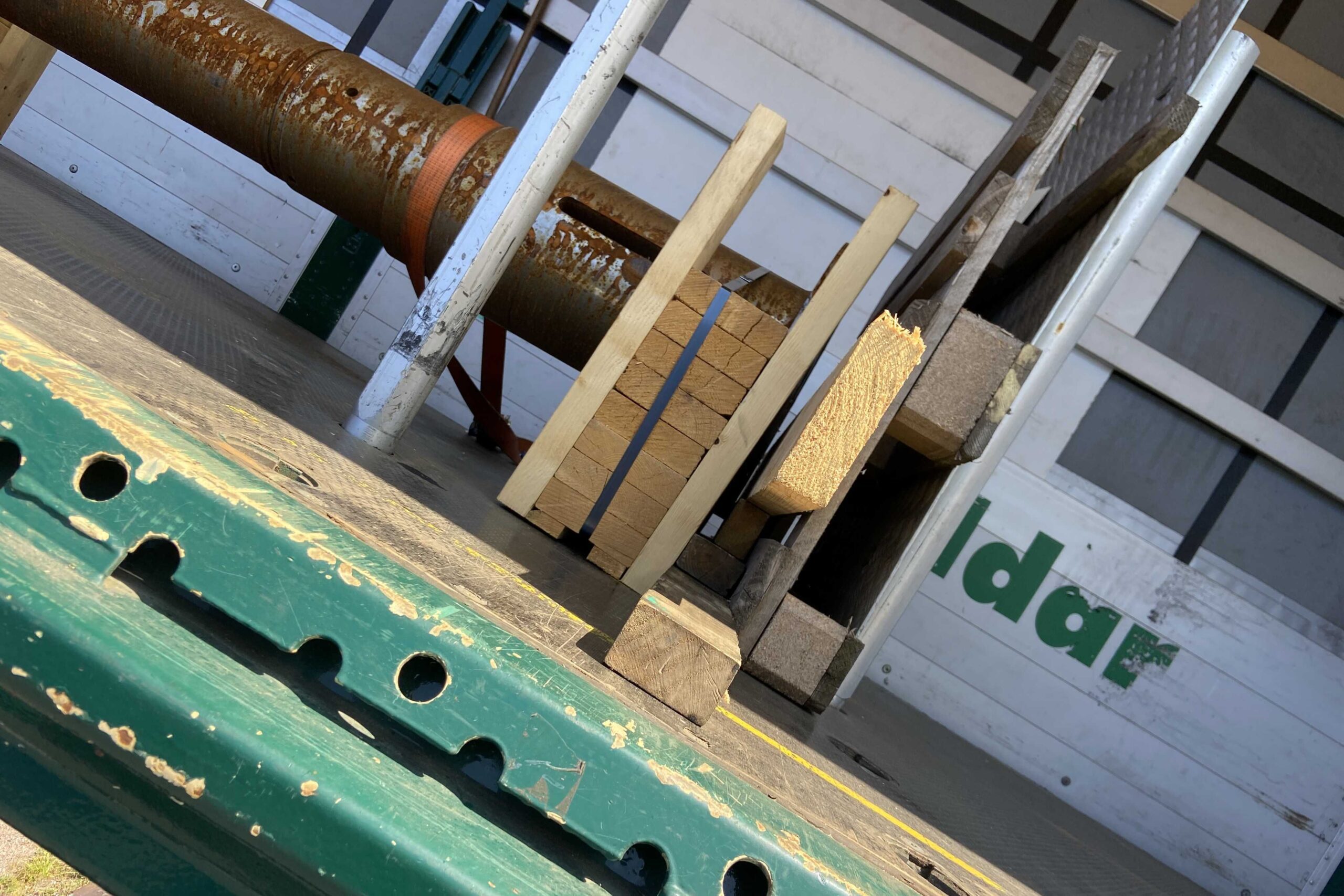
Cargo securing equipment for blocking of cargo
Blocking of cargo means that the cargo is prevented from moving by filling or placing it directly against strong structures on the load carrier. Such structures are, for example, the front wall and side walls of a trailer, the walls and doors of a container or fixed edge strips along the sides of the load carrier.
Goods loaded tightly against the front wall and side walls of a trailer, the walls and doors of a container or fixed edge strips along the sides of the load carrier can be considered blocked if the total free space laterally and longitudinally does not exceed 15 cm. Blocking of cargo is the simplest and cheapest method and should therefore always be used if possible.
In addition to fixed blocking details, some load carriers are also equipped with special brackets for removable supports, which increases flexibility and facilitates load securing during transport where the entire surface of the load carrier is not filled. Another common method of blocking is the use of wooden battens, which are adapted to the load. Depending on the design of the batten construction, the goods can be prevented from either sliding and/or tipping over. Filling with empty pallets or airbags can also be used.
Posts and stanchions
Stanchions are available in a variety of designs and the areas of application vary depending on location and strength. Stanchions along the sides of the load carrier are mainly used to secure goods on open load carriers, e.g. when transporting timber or other long goods. Other load carriers are equipped with sockets in the platform that can be used for movable stanchions, which provides great flexibility.
Movable stanchions are particularly useful when transporting high-density goods such as steel or stone products, as these may need to be loaded with a large gap between the different load units. The movable stanchions can be used to prevent sliding and tipping forwards, backwards or sideways.
The strength of each stanchion is specified by the manufacturer and this information must be available during loading. It is also important to be aware that the strength of the stanchion decreases the higher up the load is applied. The maximum load is therefore usually specified at a certain height above the platform.


Some examples of different types of cargo securing equipment in the form of stanchions and posts are cargo bars for light goods, loading and shoring beams.
Dunnage bags
Dunnage bags are a common form of cargo securing equipment used to fill free space in the load. They are most often used to fill free space laterally, but can also be used to fill free space longitudinally, e.g. in a container. Dunnage bags are available in different sizes and strengths (burst pressure).

It is important that dunnage bags are filled to the correct pressure, usually between 0.1 and 0.3 bar. If the pressure becomes too high, they may explode during transport, e.g. due to large temperature variations. It is also important to protect the dunnage bags from sharp objects and sharp edges to avoid puncture.
Note that dunnage bags must never be placed directly against the doors of the load carrier, as this risks pushing the doors open with a violent force. Dunnage bags intended to fill free space longitudinally are therefore preferably placed inside the last section of the load carrier.
Dunnage bags should be avoided in load carriers with soft sides.
Empty pallets
A suitable way to fill free space in the load to achieve a correct load distribution on the load carrier in combination with tight packing of all packages is to use empty pallets placed on their edges. For the goods to be considered secured, the free space must not exceed 15 cm, which is based on the height of the EUR pallet.
If empty pallets placed on their edges are used as cargo securing equipment when securing against the doors of the load carrier, there is a risk that they will fall out when the doors are opened. To avoid accidents, they should therefore be secured with, for example, lashing straps or ropes, or alternatively placed further into the load.
Wooden structures
Wooden structures of various kinds, site-built or prefabricated, can be used to advantage for blocking as cargo securing equipment.
In order not to create point loads, transverse battens should be used as supports between spacer battens and cargo, as well as against the walls of the load carrier. The timber dimension in both simple and more extensive blocking arrangements should be at least approx. 50 x 100 mm (2″x4″).
When loading in containers, goods with limited weight can be blocked against longitudinal movement by inserting transverse battens into the corrugation of the container. The battens are held up by vertical planks or ropes. Normally, battens of dimensions 100 x 100 mm (4″x4″) are used. Such a batten can block a maximum of approx. 5 tonnes of goods against longitudinal movement. The blocking effect is greater the closer the batten is placed to the floor.

To avoid the spread of harmful insects when exporting goods outside Europe, wood used for packaging or blocking must be heat treated and marked according to the ISPM 15 standard. Detailed instructions and requirements can be found on the Swedish Board of Agriculture’s website.
Different types of cardboard structures can also be used as cargo securing equipment for blocking of goods. Note, however, that they only have limited strength. As cardboard is constructed according to a special profile pattern, the material is sensitive to how it is loaded.
Lashing equipment for cargo securing
Lashing equipment for cargo securing is available in a variety of materials, strengths and designs, which are more or less suitable for securing different types of goods. When selecting the type and strength of lashing equipment, the strength of the lashing points on the load carrier must also be taken into account.
Lashing equipment of different strengths and materials should not be combined for securing one and the same load unit.
Many countries require load securing equipment to be marked. The EU Flying Inspection Directive will require load securing equipment used for road transport in Europe to be marked with its strength in accordance with the European standards EN 12195-2 for lashing straps, EN 12195-3 for chains and EN 12195-4 for wire. There are other standards that apply in other parts of the world.
Lashing straps with tensioners
Lashing straps with tensioners are a very common type of cargo securing equipment used in many contexts and in different types of cargo securing arrangements, both on land and at sea. The equipment consists of two parts, the short part which is attached to the tensioner and the long part which is completely detached. Both are fitted with hooks at one end.
Spännband med spännare
Spännband med spännare är en mycket vanlig typ av lastsäkringsutrustning som används i många sammanhang och vid olika typer av lastsäkringsarrangemang, både på land och till sjöss. Utrustningen består av två delar, den korta delen som är fäst i spännaren och den långa delen som är helt fristående. Båda är försedda med krokar i ena änden.

Lashing straps are available in many designs with varying widths, lengths and strengths. The most common lashing strap equipment has a breaking strength of approx. 4 tonnes, which gives a safe load LC/MSL of between 1,600 daN and 2,000 daN depending on the rules applied.
The pre-tensioning force is designated STF and is normally a maximum of approx. 350 daN, which is achieved with a manual force SHF of 50 daN. The unit daN is used for forces and strengths, and 1 daN is approximately equal to 1 kg.
Lashing straps are sensitive to sharp and pointed edges, which will eventually cause them to wear out or break. Dirt and some chemicals are other examples of factors that have a negative impact on the strength of the straps. It is therefore important to continuously inspect and assess any damage and signs of impairment. Equipment that is no longer considered to meet the requirements for safe transport must be discarded or repaired.
To protect lashing straps from sharp edges and corners, wear protection and different types of edge protection/edge profiles can be used to prevent the strap from breaking.
According to the European standard EN 12195-2, lashing straps must be marked as follows.

Explanation:
1 daN = 1 kg, LC = Lashing Capacity = Permitted load = 1600 daN (1600 kg) (at sea MSL = Maximum Securing Load), STF = Standard Tension Force = Pre-tensioning force = 400 daN (400 kg), SHF = Standard Hand Force = Hand force for which the tensioner is dimensioned = 50 daN (50 kg).
Chain lashing
Chains are mainly used for securing heavy goods that require extra strength in the cargo securing arrangement, such as vehicles, project cargo and machinery. Chains are also often used for goods that require extra durable cargo securing equipment, such as concrete elements and stone products.
Chains are available in different material qualities and dimensions, as well as with short and long links, and the choice depends on the area of application. When cargo securing requires the chain to pass over a sharp edge, there is a risk that the links in a long-link chain will bend or break, and in such cases it is more appropriate to use a short-link chain. However, short-link chain weighs slightly more than long-link chain of the same strength.
Common chain dimensions for cargo securing in road transport are 8 or 10 mm short-link chain, while long-link chain 9, 11 or 13 mm is often used for cargo securing in sea transport.
However, the strength of the chain is not only determined by the thickness of the link, but also the quality of the material plays a role. The most common material for chains used for cargo securing / lastsäkring is grade 8, but other grades are also available. Grade 10 chains are 25% stronger than grade 8 chains of the same dimension. The person performing the cargo securing should therefore refer to the chain’s marking tag, which states the chain’s strength, MSL/LC.

Explanation:
1 daN = 1 kg, 10kN = 1 tonne, LC = Lashing Capacity = Permitted load = 63 kN = 6.3 tonnes, STF = Standard Tension Force = Pre-tensioning force = 1600 daN (1600 kg). Permitted load can be expressed as LC, MSL or SWL, permitted load is 50% of the chain’s breaking strength, MCL.
The breaking strength of this chain is therefore 12.6 tonnes.
To obtain pre-tensioning force in chain lashings, a manual tensioner in the form of a turnbuckle or a tightening buckle is usually used. Pneumatically powered machine tensioners (Speed-lash) are mainly used for securing cargo on board ships.
Wire
Wire lashing is most commonly used as cargo securing equipment for securing machinery and project cargo during sea transport. They are then usually secured with wire locks and tensioned using a simple turnbuckle. It is important to apply wire lashings correctly in order to obtain as little loss of strength as possible in the arrangement. It is also important that the wire locks are positioned correctly with the “neck” towards its short end, see sketches below, and that the threads in the locks are lubricated.

Contact
Send a message
Contact details
Contact person
Phone
Address
MariTerm AB
Sporthallsvägen 2A
263 35 Höganäs
Sweden