
Cargo Securing – Rules and Guidelines
Table of contents
Here you can quickly find what you are looking for!
Rules and Guidelines for Cargo Securing on Road
European Rules and Guidelines for Cargo Securing in Road Transport
For cargo securing within Europe, the standard EN 12195-1:2010 specifies technical requirements for the dimensioning of cargo securing arrangements. This standard is not mandatory in itself, but in addition to the fact that some countries refer to the standard in their national legislation, there are three important documents that all refer to the standard as an acceptable level of cargo securing: the ADR Convention, the EU Directive on Roadside Inspections, and the European Best Practice Guidelines on Cargo Securing for Road Transport.
Contact details
Contact person
Phone
Address
MariTerm AB
Sporthallsvägen 2A
263 35 Höganäs
Sweden
ADR Convention
According to the ADR Convention, the securing of dangerous goods shall be considered sufficient if the goods have been secured in accordance with standard EN 12195-1:2010. Since ADR is an international convention, it takes precedence over national legislation, which means that with this wording, there are equal requirements for securing dangerous goods throughout Europe.
EU Directive on Roadside Inspections
In 2014, MEPs in Brussels agreed that the EU Directive on Roadside Inspections should also include guidelines on how cargo securing should be checked. The directive refers, among other things, to the European standard EN 12195-1. By May 2017 at the latest, all countries must have updated their legislation to include the requirements of the new directive, and by May 2018 at the latest, the new legislation must enter into force in all Member States. The interpretation of the directive is that at the latest when it enters into force, there will be the same requirements for cargo securing in road transport in all EU Member States, and with this, a major step has been taken towards simplified cross-border transport.
The EU Directive 2014/47/EU in all EU languages can be found at the following link:
European Best Practice Guidelines on Cargo Securing for Road Transport
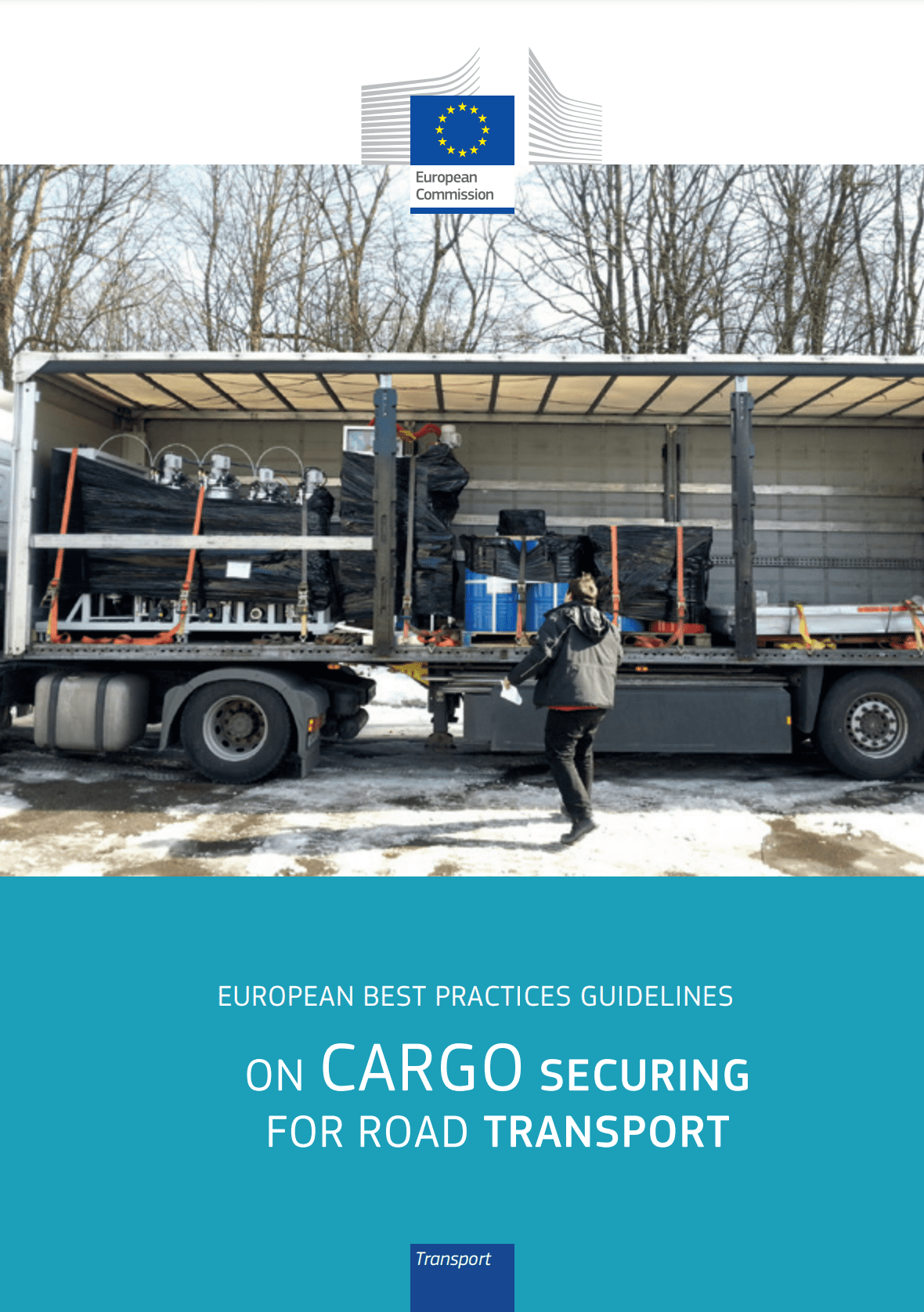
In 2014, the European Commission revised its guidelines for cargo securing: European Best Practice Guidelines on Cargo Securing for Road Transport, which are based on the EN 12195-1:2010 standard. The purpose of these guidelines is to provide basic practical advice and instructions to all those involved in the loading, securing and unloading of goods on vehicles. They are also useful for authorities carrying out supervision and in court rulings.
European Best Practice Guidelines on Cargo Securing for Road Transport in all EU languages can be found at the following link:
European Best Practice Guidelines on Cargo Securing for Road Transport

Swedish Cargo Securing Regulations
The effect of EU Directive 2014/47/EU was that Sweden had to produce a new regulation to comply with the European standard. Regulation TSFS 2017:25 – Transportstyrelsen’s regulations and general advice on cargo securing and control of cargo securing on and in vehicles, which entered into force in May 2018, contains only functional requirements and includes basic requirements such as dimensioning accelerations, frictions and safety factors. The regulation thus gave free rein to secure loads in different ways as long as the basic requirements were met.
The Swedish cargo securing regulation TSFS 2017:25 can be found at the following link: TSFS 2017:25 – Transportstyrelsen’s regulations and general advice on cargo securing and control of cargo securing on and in vehicles
As a guide and to clarify what applies to road transport in order to meet the requirements set out in Regulation TSFS 2017:25 and the standards referred to in Directive 2014/47/EU, TYA, together with MariTerm, has developed an industry standard that gives examples of how different types of goods can be secured in accordance with applicable rules. In addition to the methods specified in the industry standard, other cargo securing arrangements may also be used if they meet the requirements of the regulation. This can be shown by using TYA’s quick lashing guide, apps, technical calculation, practical tests or reference to other sources, such as:
- European Best Practice Guidelines on Cargo Securing for Road Transport (EUBPG)
- IMO/ILO/UN ECE Code of Practice for Packing of Cargo Transport Units (CTU Code)
- IRU International Guidelines on Safe Load Securing for Road Transport
TYA Industry Standard (in swedish) is available for download here.
Rules and Guidelines for Cargo Securing on Rail
UIC Loading Guidelines for Cargo Securing in Rail Transport
There are no national rules for cargo securing in rail transport, as there are for road and sea transport, and this is because rail safety is regulated at EU level and is based on Member States giving infrastructure managers and railway undertakings responsibility for operational safety work. The Swedish Transport Agency interprets the EU rules as meaning that there must be no national rules on cargo securing and that it is therefore the responsibility of each train operator to demonstrate through risk analyses that they have cargo securing routines that make rail transport safe.
However, there are European guidelines for cargo securing in rail transport, the UIC Loading Guidelines, which have been drawn up by the European Rail Union, UIC, and which apply to transport in both ordinary freight wagons and combined units. The guidelines only specify requirements for acceleration levels, and no other parameters or formulas, which means that it is not possible to dimension cargo securing arrangements yourself. The load cases and examples in the guidelines have been tested through experience and there is no link between the cargo securing in these examples and dimensioning accelerations. The accelerations given in the UIC guidelines are also higher than those given in other codes, regulations and standards and than those that have emerged through several research projects within the EU.
UIC’s cargo securing guidelines are partly translated into Swedish, partly by Green Cargo and partly by the Industry Organisation Train Operators. Some train operators refer to these translations.

Rules and Guidelines for Cargo Securing at Sea
International Code of Practice for Cargo Securing in Cargo Transport Units in Sea Transport
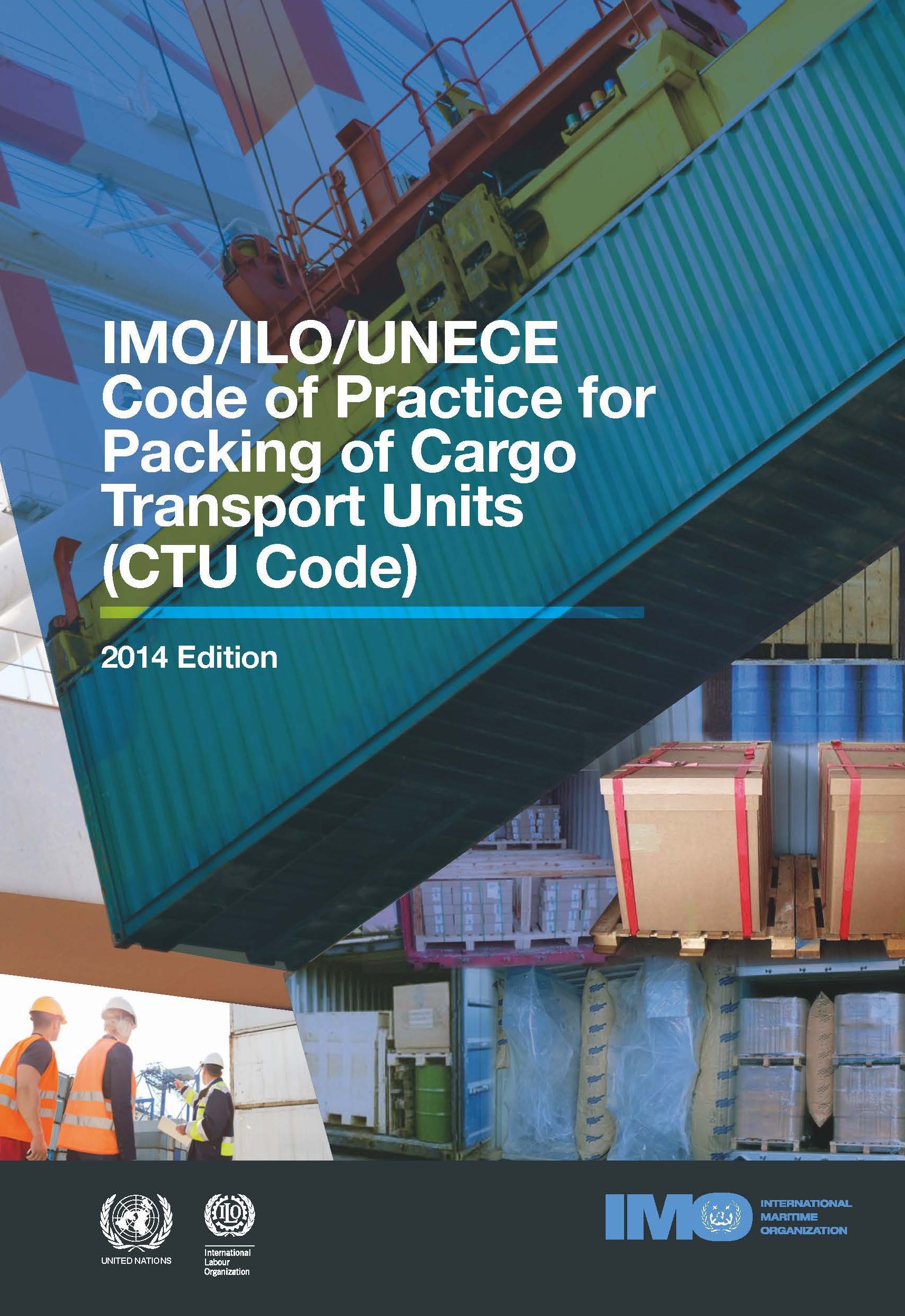
The International Code of Practice for Packing of Cargo Transport Units (CTU Code) was adopted in November 2014 by the three UN agencies IMO, ILO and UNECE.
The code is available in the form of two IMO circulars, one for the code itself with main text and appendices and one with supplementary material. The code itself is extensive and contains much more than just for cargo securing. The cargo securing information is concentrated in Chapter 9 and especially Annex 7.
In the supplementary material, in Informative Material, there is the CTU quick lashing guide to be used when dimensioning cargo securing arrangements to be transported by road, in combined transport by rail and in maritime area A, B or C.
The two IMO circulars can be found at the following links:
- MSC/Circ. 1497: IMO/ILO/UNECE Code of Practice for Packing of Cargo Transport Units (CTU Code)
- MSC/Circ. 1498: Informative Material related to the IMO/ILO/UNECE Code of Practice for Packing of Cargo Transport Units (CTU Code)
The international regulations for the transport of dangerous goods by sea, the IMDG Code, the international Code of Safe Practice of Cargo Stowage and Securing, the CSS Code (which only deals with how units are secured to ships, not how cargo is to be secured inside cargo transport units) and the Swedish national regulation TSFS 2010:174 for maritime transport are some of the documents that refer to the CTU Code.
Swedish Regulation TSFS 2024:10 for Sea Transport
The requirements for cargo securing on Swedish ships and for cargo going out over Swedish ports are regulated in TSFS 2024:10 – Transportstyrelsen’s regulations and general advice on the transport of cargo on ships and terminals called at by ships loading or unloading solid bulk cargo. The regulation specifies both how goods are to be secured inside cargo transport units and how cargo units are to be secured to the ship.
The Swedish Maritime Regulation TSFS 2024:10 can be found at the following link: TSFS 2024:10 – Transportstyrelsen’s regulations and general advice on the transport of cargo on ships and terminals called at by ships loading or unloading solid bulk cargo.
MariTerm AB, together with the Swedish Coast Guard, has translated the CTU quick lashing guide into Swedish. There are also a few different variants of the quick lashing guide, including one that is adapted to cargo securing in containers for transport by road, combined transport by rail and in maritime area C (the world’s oceans). If a cargo securing arrangement is dimensioned in accordance with a quick lashing guide applicable to the current transport, the requirements of both the CTU Code and the Swedish regulation are met.
Quick lashing guide for the CTU Code is available for download here.
Additional information
Contact
Send a message
Contact details
Contact person
Phone
Address
MariTerm AB
Sporthallsvägen 2A
263 35 Höganäs
Sweden