
Manoeuvring Trials
Table of contents
Here you can quickly find what you are looking for!
Manoeuvring trials – Manoeuvring characteristics
Over the years, MariTerm AB has conducted a number of manoeuvring trials with ships in accordance with IMO recommendations and regulations from the ship’s administration and classification society.
We can therefore undertake to plan, lead and document trials as described below.
Why are manoeuvring trials carried out on a ship?
To find out a ship’s manoeuvring characteristics, i.e. how the ship behaves in the water when turning and changing engine power, for example from full speed ahead to full speed astern.
During manoeuvring trials, the following characteristics, which are of essential importance for the ship’s manoeuvrability, can be evaluated:
- The ship’s ability to change course at small rudder angles
- How the ship responds to sudden changes in rudder angle
- Turning ability when larger adjustments to the course are required, e.g. turning radius at a course change of 90° or 180°.
- Stopping ability in emergency situations
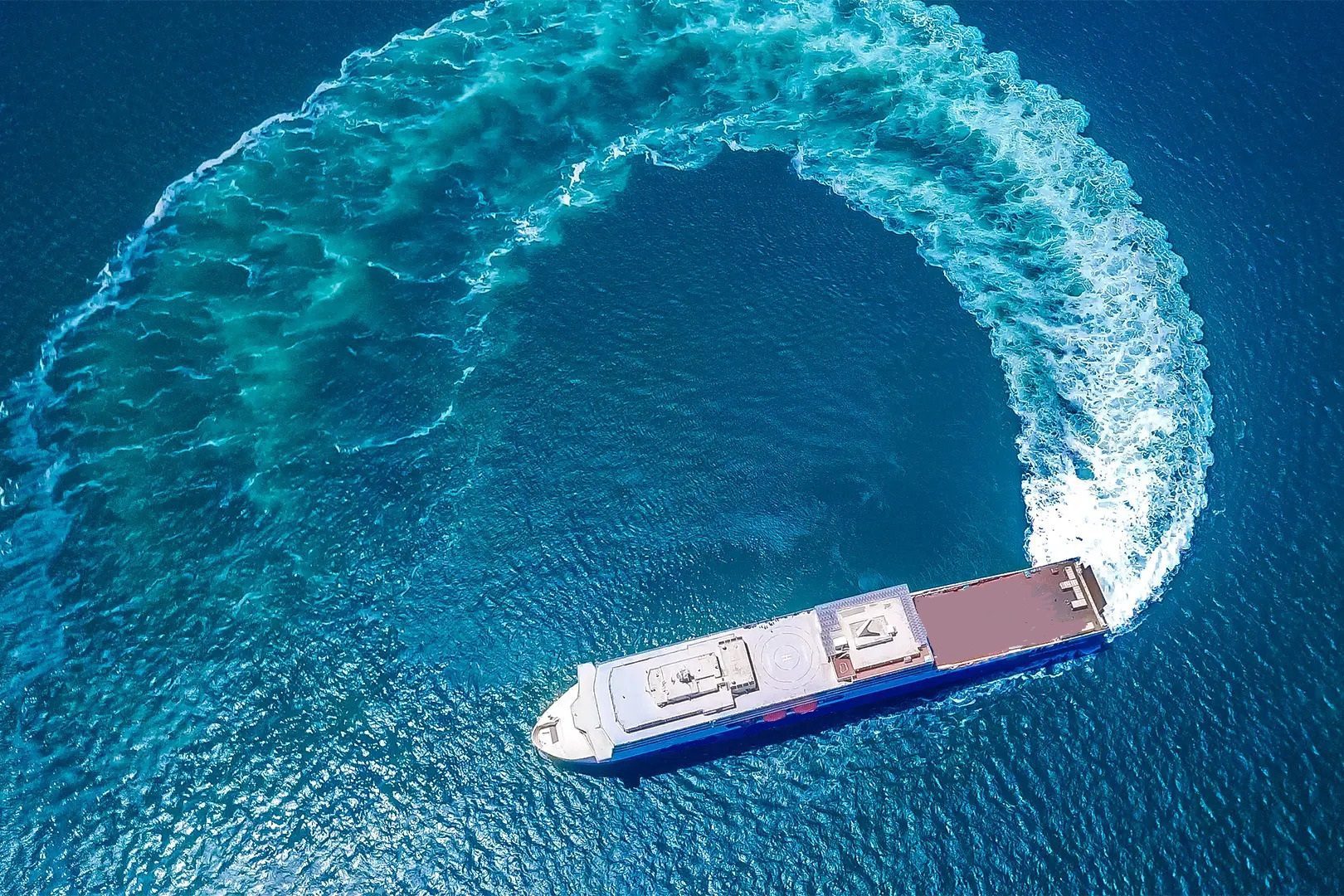
When are manoeuvring trials carried out on a ship?
A ship’s manoeuvrability is planned, tested and verified during construction through a series of manoeuvring trials in accordance with IMO requirements. This is done when the ship carries out its sea trials before the ship is handed over from the shipyard to the owner.
Likewise, if parts of the ship that may affect its manoeuvrability are replaced during the ship’s lifetime, such as the rudder system or propeller/propeller blades, manoeuvring trials may need to be carried out again to see how the manoeuvrability has been affected/changed.
How is a manoeuvring trial carried out?
Manoeuvring trials are carried out in accordance with the instructions in Standards for Ship Manoeuverability (IMO resolution MSC.137(76)) and Explanatory Notes to the Standards for Ship Manoeuverability (IMO MSC/Circ.1053).
The following manoeuvring trials are described in these regulations:
- Turning circle test
- Zig-Zag test
- Stop test
Turning circle test
This test is done to see what turning ability the ship has at larger changes of course.
According to IMO, these tests should be carried out by giving full rudder at steady speed with full speed ahead (85% MCR). The ship’s movements are then recorded until it has made a complete circle (360°). The test is repeated both to starboard and port.
It may also be desirable to carry out tests at other speeds or rudder angles, even if this is not required by IMO regulations.
The turning ability is evaluated according to the following criteria:
- Advance – The distance along the ship’s original course needed to turn 90° may not exceed 4.5 ship lengths
- Tactical diameter – The space required across the ship’s original course to turn 180° may not exceed 5 ship lengths.
For passenger ships, it is also checked that the ship’s heel angle does not exceed 10° during the trials.
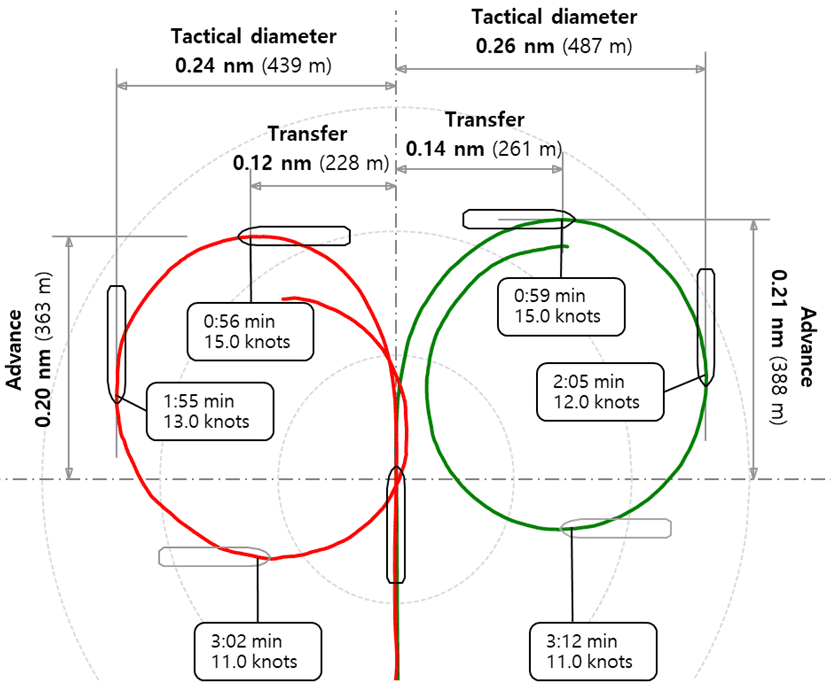
Example of the result of a turning circle test
Zig-Zag test
This test is carried out to see how much the ship deviates from the course and how long it takes to achieve the tested rudder angle and desired course change.
There are two different scenarios that should be tested according to IMO:
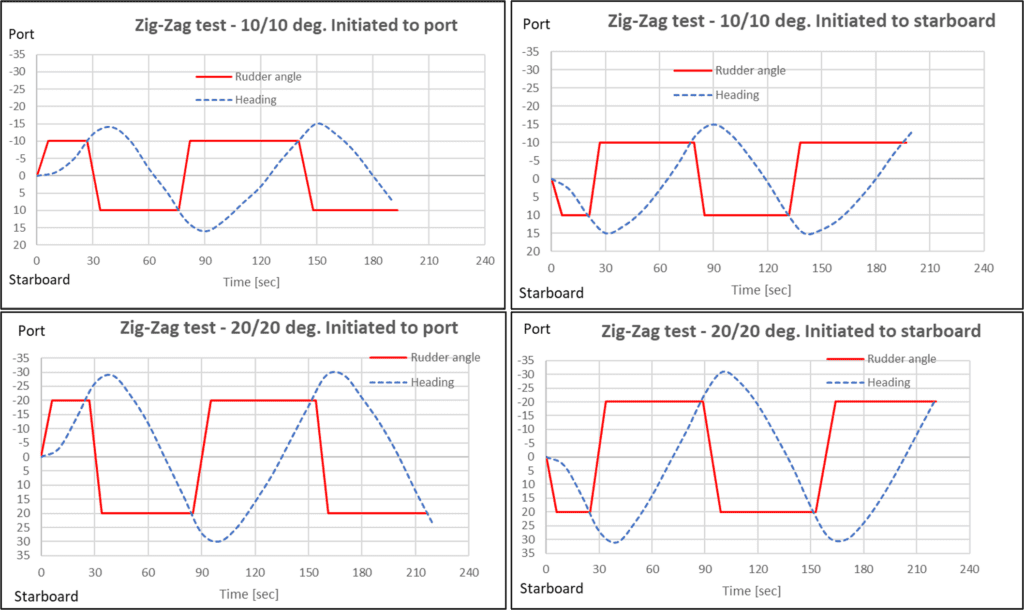
- 10° rudder angle at full speed ahead (85% MCR) with initial rudder to port and starboard respectively. In each test, the rudder angle is shifted three times when the course change matches the rudder angle.
- 20° rudder angle at full speed ahead (85% MCR) with initial rudder to port and starboard respectively. In each test, the rudder angle is shifted three times when the course change matches the rudder angle.
The requirement according to IMO for these tests is to check how quickly the ship’s rudder reacts to a larger rudder angle and the time it takes for the ship to achieve a predetermined course deviation from the original course. Likewise, the ship’s course deviation is checked when the rudder angle is changed from one side to the other.
The test proceeds as follows: The ship first turns to one side, for example port, until a certain course change has been achieved (10° or 20°), then the rudder is put over the same amount in the opposite direction, in this case to starboard. The time it takes to obtain the desired rudder angle is measured (10° or 20°) and the time it takes for the ship to achieve a course change in the opposite direction (10° or 20°) when the rudder is put over again in the opposite direction.
In addition to the time it takes, it is also measured how much the ship deviates further from the course (over shot angle) before she starts her turn in the opposite direction when the rudder angle has been changed.
Stopping test
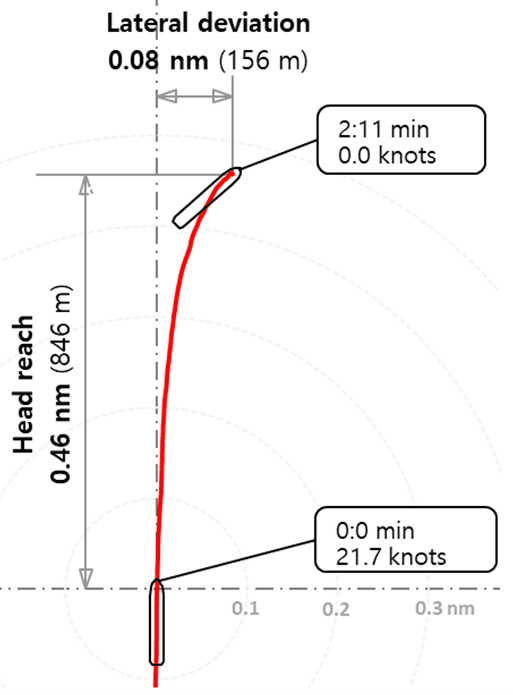
This test is carried out to see how long the stopping time and stopping distance are for the ship from full speed ahead to a stationary ship.
The test proceeds as follows: When the ship has reached full speed ahead, full astern is applied instead (full speed astern) and the time, distance (Head reach) and course deviation (Lateral deviation) are measured until the ship has stopped making headway through the water, i.e. until the ship is stationary. During the trials, the rudder should be amidships, i.e. no rudder angle should be given.
Recording of data during the manoeuvring trials
During the tests, continuous notes and digital recording of relevant data are made:
- Position
- Course
- Speed
- Rudder angle and rudder speed
- Propeller rotational speed
- Propeller pitch
- Relevant weather and current conditions
How should the ship be loaded during the manoeuvring trial?
The trials are carried out with a cargo intake that means that the ship does not deviate significantly from full draught and which is as similar as possible to the loading condition used in the original manoeuvring trials.
Who may carry out manoeuvring trials?
MariTerm AB can plan, lead and document manoeuvring trials with ships in accordance with IMO recommendations and regulations from the ship’s administration and classification society.
Documentation of the manoeuvring trials
After the manoeuvring trials have been carried out, MariTerm can produce the necessary documentation of a ship’s manoeuvring characteristics in the form of:
- Wheelhouse Poster
- Pilot Card
- Manoeuvring Booklet
- Trial report
Contact
Send a message
Contact details
Contact person
Phone
Address
MariTerm AB
Sporthallsvägen 2A
263 35 Höganäs
Sweden