
Practical Tests and Trials
Table of contents
Here you can quickly find what you are looking for!
When you need to simulate real-world forces during transport
To simulate the forces that may arise during transport, and to investigate how cargo behaves when exposed to different stresses, various practical tests can be carried out. Some simulations can be done using simple tilt tests with limited access to test material, while others require more advanced equipment, measuring instruments, and planning. The practical tests that MariTerm AB can assist with are described below.
Friction Tests
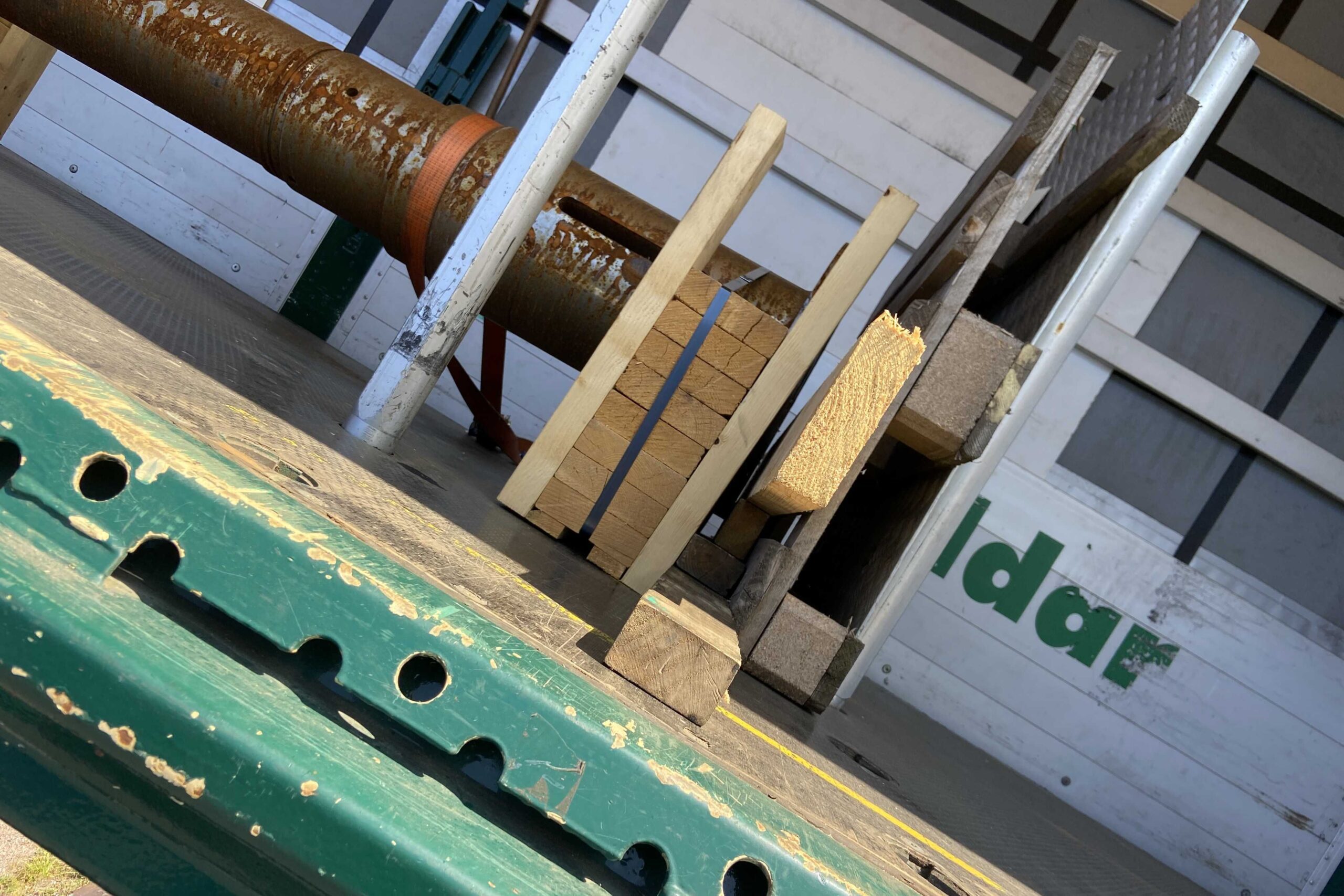
In Swedish regulations, European standards and international codes, there are friction tables with measured friction values for several different material combinations. Many types of cargo have other material combinations as contact surfaces than those that are tabulated. The Swedish road regulations state that if the friction coefficient is unknown, it is assumed to be 0.2. The corresponding value in the maritime regulations is 0.3. If a higher value is to be used, the friction must be measured in accordance with the test procedure described in the European standard EN 12195-1:2010.
According to this standard, friction can be measured using two different tests: tilt tests or tensile tests. The simplest method is to conduct a tilt test, i.e., to measure the friction by tilting the material combination you wish to test and recording the angle at which sliding occurs. The friction corresponds to the sine function of the angle. For each material combination tested, five tests shall be carried out; the highest and lowest friction values are discarded, and the average of the remaining three gives the static friction value. The friction factor, which according to the standard shall be used in the dimensioning of cargo securing arrangements, is obtained by multiplying the static friction value by 0.925.
MariTerm AB can help to prepare, carry out and document friction tests. A customer can also choose to carry out the tests themselves and we can then help to plan and/or document them. We can produce a small manual describing exactly how the customer should proceed. The customer carries out the tests and makes notes of the angles of inclination, and then we can, if desired, document the tests in a report. There are many different solutions and approaches for good cooperation.
Cargo Securing and Lashing Tests
Once the friction factor is known, cargo securing and lashing tests can be carried out to test how effective a cargo securing arrangement, which is blocked and/or lashed, is and how it copes with the stress forces to which the cargo may be exposed during transport. Tests can also be carried out to investigate how non-rigid types of cargo, e.g. big bags, drums on pallets, octabins, etc., behave when exposed to stresses and to test their shape and transport stability. Read more about transport stability testing below.
According to the European standard EN 12195-1:2010, practical tests to determine the effect of a securing arrangement can be carried out in two different ways: by driving tests or by tilt tests. In Sweden, tilt tests are mainly carried out. As an example, according to the standard, cargo securing during road transport must be able to withstand forces corresponding to 80% of the load’s weight (0.8 g = 8 m/s2) forwards. This stress force can be translated into an angle to which a lashing arrangement must be able to tilt. The lower the friction, the greater the angle the arrangement must be tilted to. If the friction between the contact surfaces is 0.4, for example, the arrangement must be able to tilt to approximately 43° in the direction of travel.
MariTerm AB can assist in the planning, execution and documentation of such tilt tests. The tests can either be carried out on site at the customer’s premises, at its factory where the various types of goods to be tested are easily accessible, or the customer sends the goods to be tested to us and we carry out the tests at a suitable location. Tests can be carried out for goods to be transported by road, in containers, in swap bodies or on flat rack containers for transport by road or sea.
Transport Stability Testing
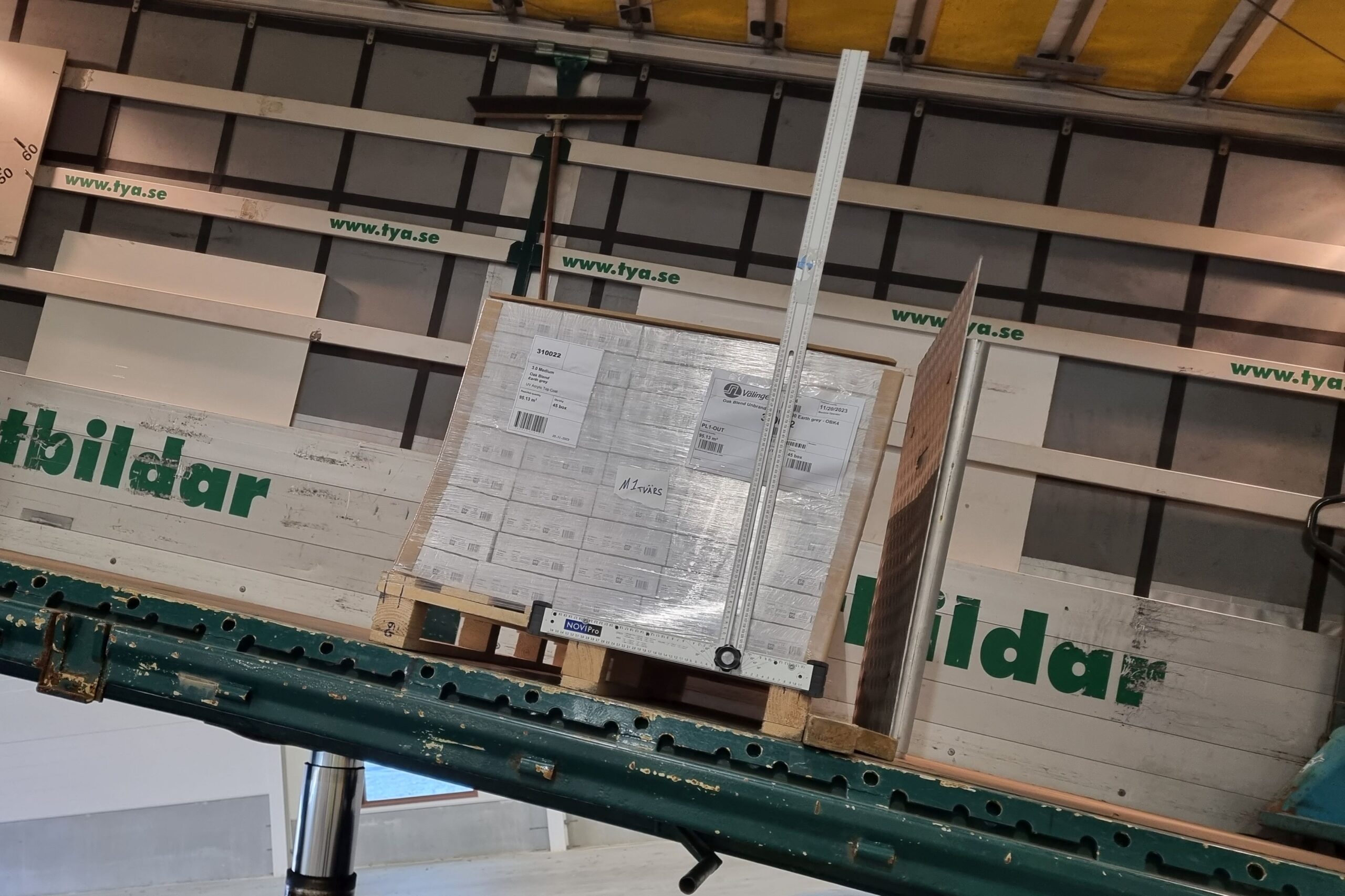
There is now a Swedish standard SS 17321:2022 for testing the transport stability level – TSL – of a package. The standard specifies how tests are to be carried out to determine the level of stress that a package and its packaging can withstand. According to the standard, the package may then be marked with a TSL level corresponding to the stress used in the tests. The aim is that by means of clear markings on the packages, loaders and drivers will be able to adapt the cargo securing to the stability of the packages, which in turn will lead to increased transport safety. These tests can also help consignors who store, handle and transport packages to check that they retain their original shape during handling in order to reduce the risk of damage to goods or that the stability of the entire load carrier is compromised.
The lowest level, TSL 5, means that the goods are safe to handle by forklift truck in storage and during loading, which corresponds to an acceleration of a ≥ 0.18 g. TSL 3 means that the goods can withstand lateral stress forces on road and rail, TSL 2 in the direction of travel on road and TSL 1 in the longitudinal direction on combined transport (rail).
To determine the TSL level according to standard SS 17321:2022, packages shall be tested according to one of the following three test methods:
a – dynamic acceleration tests on a sled
b – dynamic driving tests on a vehicle
c – static tilt tests
Tests shall be carried out on each package in at least two directions, defined according to the shape of the package.
MariTerm AB can help to carry out tests of the transport stability of packages. The tests are documented in a report and the results can be of great importance in the handling and transport of packages.
Container Tests
MariTerm AB can also assist with various types of container testing: to measure the strength of its lashing points, the strength of the container floor, how much cargo can be blocked using battens in the corrugation, the strength of various blocking arrangements, etc.
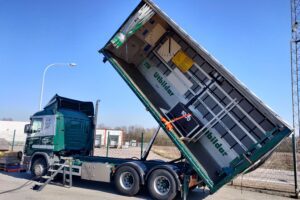
The Cargo Securing Truck
When carrying out the tests described above, TYA’s cargo securing truck can be used to advantage.
The cargo securing truck is equipped with a tiltable platform and some of the load securing equipment on the truck has been developed in a research project. In addition to using it to test various cargo securing arrangements and the transport stability of packages, MariTerm AB also uses it for training purposes as it is included in the practical elements carried out on the basic course in cargo securing.
Contact
Send a message
Contact details
Contact person
Phone
Address
MariTerm AB
Sporthallsvägen 2A
263 35 Höganäs
Sweden