
Classification of Dangerous Goods – Danger classes
Table of contents
Here you can quickly find what you are looking for!
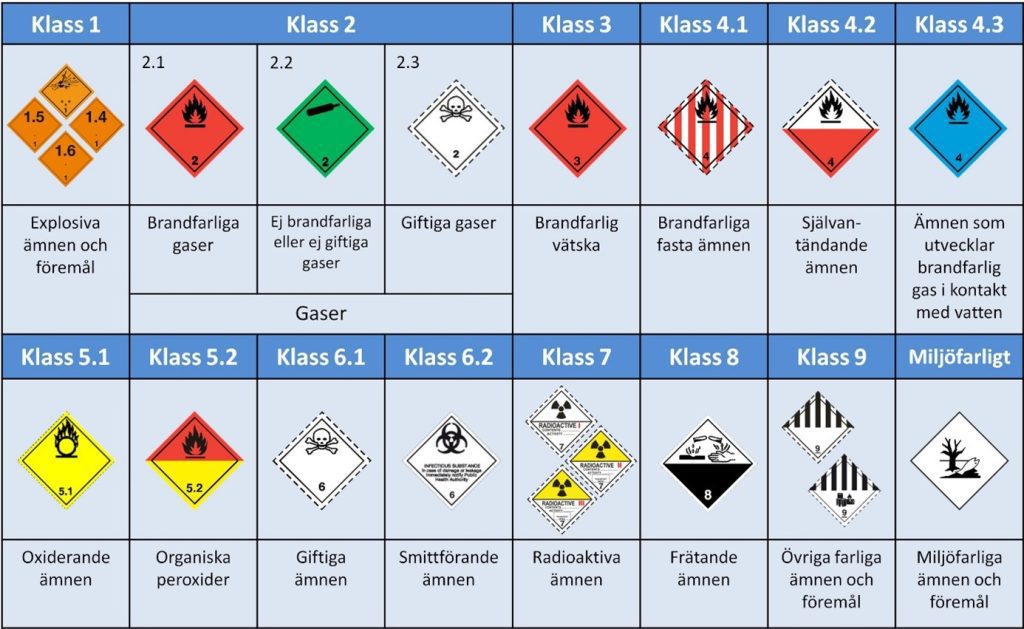
Class 1 – Explosives and articles
An explosive is a reactive substance or article, including a device that contains a large amount of potential energy that can cause an explosion if suddenly released. The explosion is usually accompanied by a production of light, heat, sound and pressure. Explosives and articles are classified into six different hazard divisions 1.1 – 1.6 according to the Test Handbook. The tests are complicated and may only be performed by a competent expert or Authority. In addition, explosives are divided into different compatibility groups A-S.
A slightly reduced definition of the different hazard division is as follows:
- Division 1.1 Substances and articles which have a mass explosion hazard
- Division 1.2 Substances and articles which have a projection hazard but not a mass explosion hazard
- Division 1.3 Substances and articles which have a fire hazard and either a minor blast hazard or a minor projection hazard or both, but not a mass explosion hazard
- Division 1.4 Substances and articles which present no significant hazard
- Division 1.5 Very insensitive substances which have a mass explosion hazard
- Division 1.6 Extremely insensitive articles which do not have a mass explosion hazard
The definition of the different compatibility groups for Class 1 substances and items is as follows:
- A – Primary explosive substance
- B – Article containing a primary explosive substance and not containing two or more effective protective features
- C – Propellant explosive substance or other deflagrating explosive substance or article containing such explosive substance
- D – Secondary detonating explosive substance or black powder or article containing a secondary detonating explosive substance, in each case without means of initiation and without a propelling charge, or article containing a primary explosive substance and containing two or more effective protective features
- E – Article containing a secondary detonating explosive substance, without means of initiation, with a propelling charge
- F – Article containing a secondary detonating explosive substance with its own means of initiation, with a propelling charge
- G – Pyrotechnic substance, or article containing a pyrotechnic substance, or article containing both an explosive substance and an illuminating, incendiary, tear- or smoke-producing substance
- H – Article containing both an explosive substance and white phosphorus.
- J – Article containing both an explosive substance and a flammable liquid or gel
- K – Article containing both an explosive substance and a toxic chemical agent
- L – Explosive substance or article containing an explosive substance and presenting a special hazard
- N – Articles predominantly containing extremely insensitive substances.
- S – Substance or article so packaged or designed that any hazardous effects arising from accidental functioning are confined within the package unless the package has been degraded by fire
Examples of substances/articles in class 1 are ammunition, fireworks and explosives.
For hazardous substances and articles in class 1, the classification code consists of the hazard division together with the compatibility group. For example, firing caps have the classification code 1.4S.
Class 2 – Gases
Gases can be pure or a mixture of one or more gases. According to the Dangerous Goods Regulations, a gas is defined as a substance that at 50°C has a vapour pressure greater than 300 kPa or if the substance is in gaseous form under a standard pressure of 101 kPa at 20°C.
According to the regulations, gases are divided into three subclasses:
- 1 – Flammable gases
- 2 – Non-flammable or non-toxic gases
- 3 – Toxic gases
The substance and articles of Class 2 are subdivided as follows:
- Compressed gas
- Liquefied Gas
- Refrigerated liquefied gas
- Dissolved gas
- Aerosol dispenser or receptacle, small, containing gas
- Other articles containing gas under pressure
- Non-pressurised gases subject to special requirements
- Chemicals under pressure
- Adsorbed gas
Except for aerosols and chemicals under pressure, gases are assigned to one of the following groups according to their hazardous properties:
- A – Asphyxiant
- O – Oxidizing
- F – Flammable
- T – Toxic
- TF – Toxic, flammable
- TC – Toxic, corrosive
- TO – Toxic, oxidizing
- TFC – Toxic, Flammable, Corrosive
- TOC – Toxic, Oxidizing, Corrosive
Examples of substances/articles in Class 2 are aerosols, fire extinguishers, lighters, acetylene, carbon dioxide, sulphur dioxide, helium, hydrogen, oxygen, nitrogen, methane, propane and butane.
For Class 2, the classification code consists of the type of gas and the group of hazardous property. For example, sulfur dioxide has the classification code 2TC.
Class 3 – Flammable liquids
The Dangerous Goods Regulations define Class 3 substances as a liquid, or a mixture of liquids, that has a flashpoint of no more than 60°C. However, diesel fuel, diesel oil, heating oil (light) and synthetically manufactured products, which have a flashpoint between 60°C – 100°C, are also considered to be substances belonging to flammable liquids. Other properties such as vapour pressure, boiling point, viscosity, etc. are also considered for a correct classification.
Flammable liquids emit a flammable vapor that, when mixed with air, can ignite or explode. Based on their flashpoint and boiling point, they can be extremely flammable, highly flammable, or flammable.
When transporting Class 3 flammable liquids by sea, the IMDG Code requires that the flashpoint be displayed as part of the description of dangerous goods in the documentation.
Class 3 subjects and articles are further divided as follows:
- F – Flammable liquids without subsidiary hazards and articles containing such substances
- F1 – Flammable liquids with a flashpoint not exceeding 60 °C
- F2 – Flammable liquids with a flashpoint above 60 °C, carried or handed over for carriage heated to or above their flashpoint
- F3 – Articles containing flammable liquids
- FT – Flammable liquids, toxic
- FT1 – Flammable liquids, toxic
- FT2 – Pesticides
- FC – Flammable liquids, corrosive
- FTC – Flammable liquids, toxic, corrosive
- D – Liquid desensitized explosives
Examples of substances/articles in class 3 are acetone, glue, paint, alcohols, perfume products, petrol, diesel fuel, aviation fuel, fuel oil, kerosene, resins, turpentine, ethanol and methanol.
The classification code for substances and articles in class 3 consists of the classification as described above. Gasoline, for example, takes the classification code F1.
Class 4.1 – Flammable solids
Class 4.1 includes flammable substances and articles, desensitised explosives, self-reactive solids and liquids and polymerising substances.
Easily flammable solids are powdery, granular or pasty substances, which are dangerous if they can be easily ignited by a short-term contact with an ignition source, such as a burning match, and the flames spread quickly. The danger can be both the fire and toxic combustion products. Metal powders are particularly dangerous due to the difficulty of extinguishing a fire, as normal extinguishing agents such as carbon dioxide or water can exacerbate the danger.
Self-reactive substances are thermally unstable substances that can undergo a strong exothermic (heat emitted) degradation even without the addition of oxygen.
Polymerizing substances are substances that, without stabilization, are prone to undergo a strong exothermic reaction (heat is emitted) that leads to the formation of larger molecules or results in the formation of polymers under conditions normally encountered during transport.
Class 4.1 substances and items are classified as follows:
- F – Flammable solids without subsidiary hazard
- F1 – Organic
- F2 – Organic, molten
- F3 – Inorganic
- F4 – Articles
- FO – Flammable solids, oxidizing
- FT – Flammable solids, toxic
- FT1 – Organic, toxic
- FT2 – Inorganic, toxic
- FC – Flammable solids, corrosive
- FC1 – Organic, corrosive
- FC2 – Inorganic, corrosive
- D – Solid desensitised explosives without subsidiary hazard
- CT – Solid desensitized explosives, toxic
- SR – Self-reactive substances
- SR1 – Not require temperature control
- SR2 – Require temperature control
- PM – Polymerizing substances
- PM1 – Not require temperature control
- PM2 – Require temperature control
Examples of substances/articles in class 4.1 are matches and metal powders.
The classification code for substances and articles in class 4.1 consists of the classification as described above. For example, matches have the classification code F1.
Class 4.2 – Substances liable to spontaneous combustion
Class 4.2 covers substances and articles, including mixtures and solutions (solid or liquid) that are pyrophoric, i.e. that ignite within 5 minutes even in small quantities when in contact with air, and self-heating substances that are prone to temperature rise in contact with air without energy input. These substances can catch fire only in large quantities (several kilograms) and after a long time (hours or days).
Subjects and articles in class 4.2 are divided as follows:
- S – Substances liable to spontaneous combustion, without subsidiary hazard
- S1 Organic, liquid
- S2 Organic, solid
- S3 Inorganic, liquid
- S4 Inorganic, solid
- S5 Organometallic
- S6 Articles
- SW – Substances liable to spontaneous combustion, which in contact with water, emit flammable gases
- SO – Substances liable to spontaneous combustion, oxidizing
- ST – Substances liable to spontaneous combustion, toxic
- ST1 Organic, toxic, liquid
- ST2 Organic, toxic, solid
- ST3 Inorganic, toxic, liquid
- ST4 Inorganic, toxic, solid
- SC – Substances liable to spontaneous combustion, corrosive
- SC1 Organic, corrosive, liquid
- SC2 Organic, corrosive, solid
- SC3 Inorganic, corrosive, liquid
- SC4 Inorganic, corrosive, solids
Examples of substances/articles in class 4.2 are coal and fishmeal.
Fishmeal has the classification code S2, which is thus made up of the classification above.
Contact
Send a message
Contact details
Contact person
Phone
Address
MariTerm AB
Sporthallsvägen 2A
263 35 Höganäs
Sweden