
Exemptions for dangerous goods
Table of contents
Here you can quickly find what you are looking for!
Limited quantity
Dangerous goods that are packed in appropriately small quantities can be transported under the exemption limited quantity (LQ). The provisions on limited quantities are contained in Chapter 3.4 of the ADR/RID/IMDG Code and in Chapter 2.8 of IATA and implies some relaxations from the regulations.
Dangerous goods that are transported in limited quantities must either be packed in a combination packaging, which means that inner packaging(s) are placed in an outer package, such as plastic bottles in a cardboard box, or on shrink or stretch filmed trays. The packaging does not need to be type-approved, but it must be of good quality and sufficiently durable to withstand the stresses of normal transport conditions.
The amount of dangerous goods per inner package shall not exceed the maximum permitted quantity per inner package specified in column 7a of the Dangerous Goods List of ADR/RID/IMDG and column H of IATA. The maximum permissible gross weight for a combination packaging is 30 kg, while the corresponding maximum weight for stretched or shrink-filmed trays is 20 kg.
Each outer package or tray shall be clearly and durably marked with the limited quantity mark as set out below. This marking is the same for all modes of transport, but with the addition of a “Y” in the case of an air transport.


Some provisions that do not apply to the road transport of dangerous goods in limited quantities include the requirement for goods declarations, written instructions, placarding or orange plates and marking of vehicles with limited quantities of less than 8 tonnes and a total weight of less than 12 tonnes, some vehicle equipment and the driver’s ADR certificate.
In the case of maritime transport in accordance with the IMDG Code, the transport of dangerous goods in limited quantities is assigned to stowage category A, no separation is required on CTU and at stowing onboard and that CTUs are marked with the limited quantity placard.
Before the transport begins, the consignor must inform the carrier of the quantity of dangerous goods to be transported as a limited quantity. If the goods are to be transported by sea, a Container/vehicle Packing Certificate (CPC) may accompany the transport, but this is not a requirement.
Excepted quantities
Dangerous goods that are packaged in very small quantities can be transported under the exemption of excepted quantity (EQ).
Like limited quantity exemption, the application of excepted quantities is based on the dangerous goods packed in small quantities. This exemption originates from the rules on the carriage of dangerous goods by air and therefore is the quantity restrictions and requirements harmonised between the different modes of transport.
The quantity limits are set out in the form of codes E0 to E5 in column 7b of the Dangerous Goods List of the ADR/RID/IMDG code and in column F of IATA. Each UN number has a assigned code where E0 means that the substance are not allowed to be transported in excepted quantities. Each code indicated the weight restrictions per inner and outer packaging. These limitations must not be exceeded. If dangerous goods with different codes are to be packed together in the same outer packaging, it is the most restrictive code that determines the maximum quantity that the outer packaging may contain.
The maximum number of packages in excepted quantities in the same CTU is limited to 1000 packages.
The packages do not need to be type-approved, but they must pass drop and stacking tests without either bursting or leaking. The tests can be carried out as self-monitoring and must be documented by the person performing them. The tests must be carried out on packages in a ready-to-transport condition.
The dangerous goods must be packed in inner packaging, intermediate packaging and outer packaging.
The inner packaging must have a secure closure and be made of plastic, glass, porcelain, stoneware, earthenware or metal.
The inner packaging must be packed securely in an intermediate package filled with shock-absorbing material. If the inner packaging get broken, the intermediate packaging shall be designed to contain the leakage and, if the inner packaging contains liquid, the intermediate packaging shall contain absorbent material in such quantities that the total amount of liquid can be absorbed.
Finally, the intermediate packaging must be packed in a sturdy and rigid outer package, for example made of cardboard or wood. Each outer package must be large enough to fit all the prescribed labelling.
Packages containing dangerous goods in excepted must be permanently and clearly marked with the excepted quantity mark including their primary hazard for each type of dangerous goods (1). The marking shall also include the names of either the consignor and the consignee (2), if not shown elsewhere on the package.
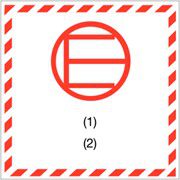
If dangerous goods in excepted quantities are accompanied by one or more documents (for example, ‘Bill of lading’, ‘Air waybill’ or CMR/CIM (rail waybill)), the number of packages and the following note shall be indicated in at least one of the documents: ‘DANGEROUS GOODS IN EXCEPTED QUANTITIES’.
Small load quantity
This exemption is described in ADR subsection 1.1.3.6 with the heading ‘Exemption related to quantities carried per transport unit’ but can also be called ‘small load quantities’ and is another exemption when some provisions don’t have to be followed.
Unlike the transport of excepted and limited quantities, the dangerous goods do not need to be packed in smaller packages when the small load exemption is used. It is the total amount of dangerous goods on a transport unit (vehicle with or without a trailer) that determines whether the small load quantity exemption can be applied. The exemption can only be used if the dangerous goods are transported in packaging, IBC or large packages.
Each UN number belongs to a specific transport category that specifies the maximum allowable total quantity of the substance. The information about the transport category can be found in column 15 of the Dangerous Goods list in ADR. There are five different transport categories: 0, 1, 2, 3 and 4.
Transport category 0 means that the goods may not be transported as small load quantity
Transport category 1 means that the amount in litres or kilograms is multiplied by 50
Transport category 2 means that the amount in litres or kilograms is multiplied by 3
Transport category 3 means that the amount in litres or kilograms is multiplied by 1
Transport category 4 means that unlimited quantities may be transported as small load quantity
The main principle is that the more dangerous the goods, the higher the score for which the weight or volume is determined. The total points during a carriage must not exceed 1000 points.
When transporting dangerous goods in small load quantities, some provisions in the ADR regulations don’t have to be followed, among other things, vehicle marking, driver’s ADR certificate, instructions in writing and some safety equipment.
When dangerous goods are to be transported in small load quantity, the dangerous goods declaration must also contain information on the total quantity of dangerous goods for each transport category.
It is the normally the transporter who decides whether the dangerous goods should be transported as small load quantity.
Contact
Send a message
Contact details
Contact person
Phone
Address
MariTerm AB
Sporthallsvägen 2A
263 35 Höganäs
Sweden