
Cargo Securing – Basic Principles
Table of contents
Here you can quickly find what you are looking for!
Forces Acting on Cargo During Transport
The following forces, among others, act on a cargo unit during transport:
- Gravitational force
- Inertia forces (mass forces)
- Friction forces
- Vibration forces
Before a vehicle starts to move, it is basically only the gravitational force that affects a cargo unit standing on a truck bed. The force of gravity is caused by the Earth’s gravitational pull and acts straight down in a vertical direction.
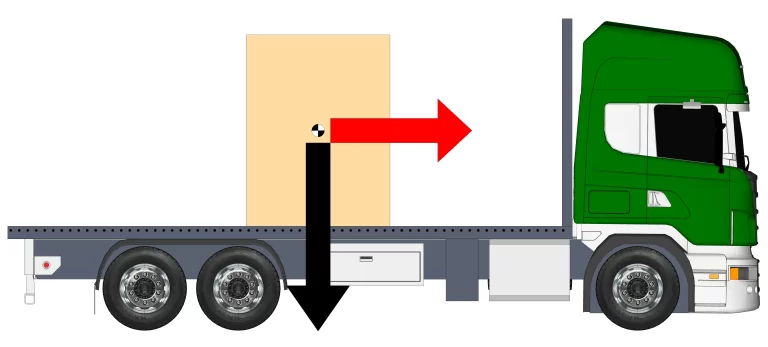
A force acting on a unit is physically calculated as the multiplication between the unit’s mass m and the acceleration a acting on the unit: F = m×a.
Acceleration is expressed in m/s2 (metres per second squared). Earth’s acceleration is 9.81 m/s2 and is referred to as g (1g = 9.81 m/s2). If the weight of the goods is expressed in kg and the acceleration in m/s2, the force is obtained in Newtons (N), but if the weight of the goods is expressed in tonnes, the force is obtained in kilo Newtons (kN).
It is therefore not physically correct to express forces in kg and tonnes. However, this is acceptable in the context of lashing and makes the physical relationships much easier to explain and understand. With accelerations given as proportions of g, forces are obtained in kg or tonnes.
The force of gravity acting on a cargo unit standing on a stationary truck bed is equal to the weight of the goods. If a unit weighs 2 tonnes, it is thus affected by a downward force of approximately 2 tonnes.
A body thus has weight when it is on the Earth’s surface. If it is moved to the moon, the weight becomes less, about 1/6 of the weight on Earth. This is because the moon, with its smaller mass, exerts a weaker gravitational pull than Earth. Out in the universe, far from all stars, weight is practically zero. Note that the mass of a body is the same wherever it is.
If the vehicle is stationary without driving, the unit is affected partly by a downward force, the gravitational force Fmv, and partly by an upward force, the normal force FN, which, when av = 1 g, both correspond to the weight of the goods, 2 tonnes.
Inertia forces (mass forces) act on a unit when its speed changes in any direction during a goods transport. Speed increase is called acceleration and speed decrease is called retardation. Physically, a retardation is equal to an acceleration with a negative sign.
Goods are subjected to different stress forces depending on the mode of transport the goods are transported; road, rail and/or sea transport. The different modes of transport therefore place different demands on how the goods should be loaded and secured in order to withstand transport. The requirement for load securing for road transport in Europe is as follows:
Force forwards during a goods transport during heavy braking: 8 m/s2 = 0.8 g (= 0.8×Cargo weight)

Force sideways during a goods transport during sharp cornering: 5 m/s2= 0.5 g (= 0.5×Cargo weight)

- Force backwards during a goods transport during acceleration: 5 m/s2 = 0.5 g (= 0.5×Cargo weight)

When dimensioning cargo securing arrangements, it is assumed that the above accelerations occur individually. At the same time, the force of gravity acts downwards. In sea transport, the acceleration due to gravity is reduced by the dynamic vertical acceleration. Goods are subjected to different forces depending on the mode of transport, i.e. whether the goods are travelling by road, by rail or by sea.
In the same way as for the gravitational force, the mass force is calculated by multiplying the mass and the acceleration:
- Fmh = m×ah, where:
- Fmh = horizontal mass force,
- m = the mass of the goods and
- ah = the horizontal acceleration (forwards, backwards or sideways).
The unit of the force is determined in the same way as for the gravitational force.
The frictional force is the force that wants to counteract the movement of the goods when they are subjected to mass forces during transport. Other forces that counteract movements are forces that arise in closing devices and lashings.
The frictional force (Ffr) is obtained from the following formula:
- Ffr = FN×μ, where:
- FN = Normal force = the force with which the goods press against the platform and
- μ = the friction.
Ffr gets the same unit as FN. This means that if the downward forces are expressed in kN, the frictional force is also expressed in kN, and if the normal force is expressed in tonnes, the frictional force is also expressed in tonnes.
Vibration forces are short-term force shocks with low energy content that can lead to cargo movement. A single such force shock cannot move the goods any great distance due to the short duration. However, due to constant repetition over a longer period of time, vibration forces can cause unsecured goods to move, i.e. move a longer distance in any direction.
Friction
Friction is a measure of how rough the contact surface between two materials is and is denoted by the Greek letter μ. Friction has a value between 0 and 1.
If the contact surface is rough, the friction is high. Wood against wood is an example of a contact surface that is relatively rough. If the contact surface is clean and dry and free from frost, ice and snow, the contact surface of wood against wood has a friction factor of 0.45. If rubber is placed between a wooden box and a wooden platform, the roughness and thus the friction factor increases.
For slippery contact surfaces, the coefficient of friction is low. Examples of slippery contact surfaces are steel against steel. If the surfaces are also lubricated, the friction is even lower.
Friction affects how much cargo securing equipment is needed to prevent slipping between goods and the substrate and between different cargo units stacked on top of each other. The lower the friction, the more lashing equipment is needed.
Friction can be divided into static friction and sliding friction. Static friction, or static friction, is the friction between two surfaces at rest, i.e. when the surfaces are not sliding against each other. If the surfaces begin to slide against each other, the friction changes from static friction to sliding friction, dynamic friction. Dynamic friction is lower than static friction, i.e. the movement-hindering force that friction provides is greater before sliding has begun. Once sliding begins, the sliding-preventing frictional force decreases. Generally, the dynamic friction can be estimated to be about 75% of the static friction.
Friction values for typical contact surfaces are tabulated in various regulations, standards and guidelines, see for example in the CTU quick lashing guide. See example from CTU-code Quick Lashing Guide.
Tabulated values apply to clean surfaces that are free from frost, ice and snow. If this is not the case, or if the friction is not known, either general friction factors can be used which are low or the friction can be determined by practical tests.
Centre of Gravity
The centre of gravity of a cargo unit is the centre of the unit’s mass. For homogeneous goods, the centre of gravity is located in the geometric centre of the unit, i.e. at half the height, half the width and half the length. An example of homogeneous goods is a paper roll.
For non-homogeneous goods, the centre of gravity is often offset in relation to the centre of the unit. Examples of non-homogeneous goods are machines in boxes and hedges. The centre of gravity can be offset both sideways and upwards or downwards.
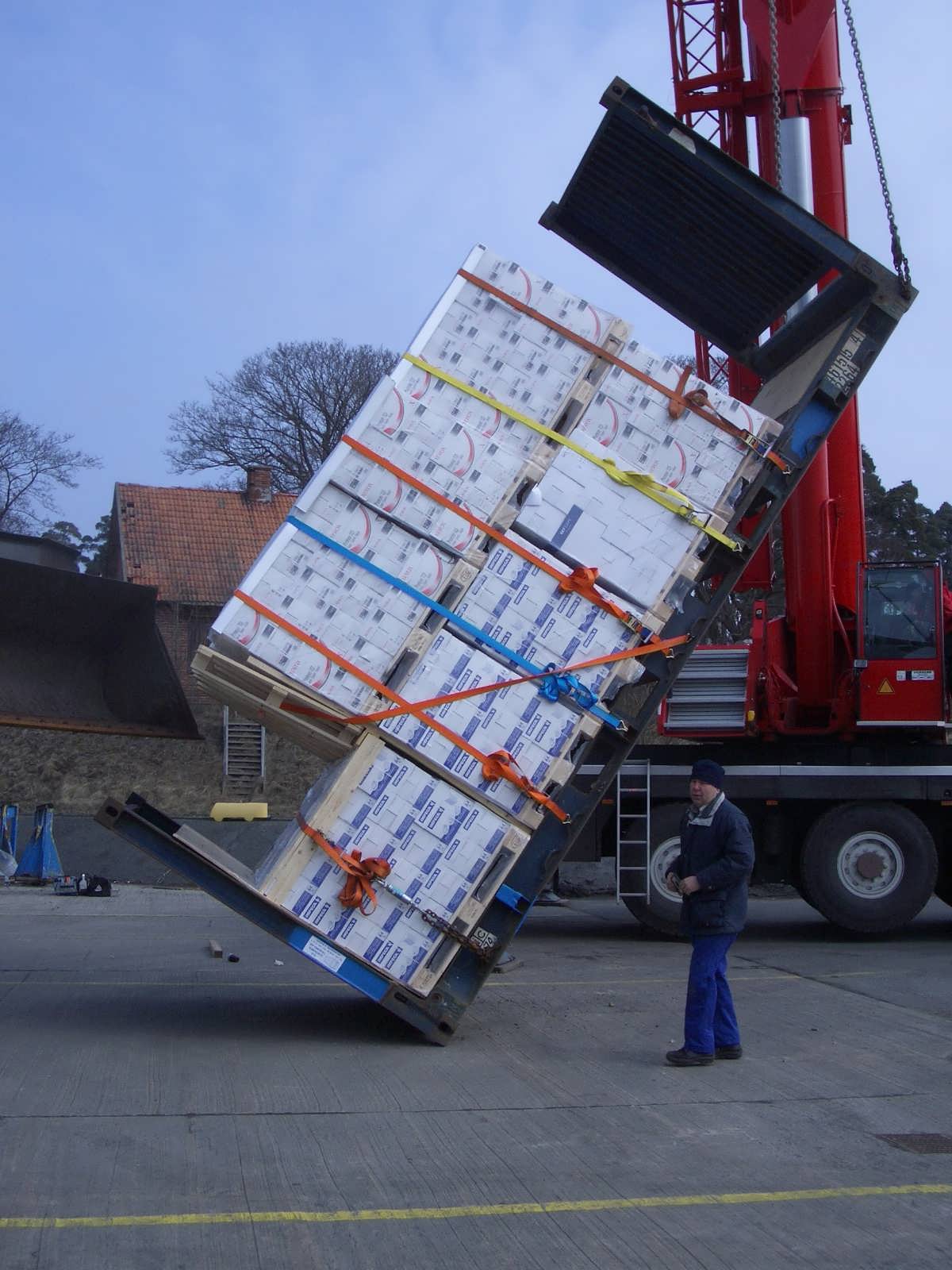
Cargo securing is most affected if the centre of gravity is heavily offset to one side or if it is located high above the centre of the unit. There is no legal requirement for the centre of gravity to be marked on a unit, not even if it is offset in relation to the centre of the unit. However, many machine suppliers usually mark the offset centre of gravity on the outside of the packaging. According to the EU Machinery Directive, however, there must be documentation with information on where the centre of gravity of machines is located for the safe handling of the machines. The international symbol for centre of gravity marking is shown in the figure below.


Sliding, Tipping and Wandering
Goods shall be cargo-secured so that they are prevented from sliding and tipping forwards, backwards and sideways and from wandering.


Whether a unit will slide or not depends on the following factors:
- The friction between the unit and the substrate
- The magnitude of the forces
If the friction is low, there is a high risk that the unit will slide. If the friction is high, it may be sufficient to prevent sliding without any further measures. Note that the weight has no significance for when a unit starts to slide, i.e. heavy goods do not remain because they are heavy. However, once sliding occurs, weight plays a major role and means that heavy goods pose a major hazard if they start to slide.
Whether a unit tips over or not depends on the following factors:
- The width and length of the unit
- The position of the centre of gravity in height, length and sideways
- The magnitude of the forces
The weight of the goods also does not affect whether a unit tips over.
If there is no risk of sliding or tipping, it may be permissible under certain circumstances to drive goods completely unsecured. Wandering can occur due to vibrations, for example on uneven road surfaces. Constant repetition of vibrations can cause unsecured goods to wander longer distances.
Further information
For further information, please contact:
You can also read more about cargo securing on our collection page link
Contact
Send a message
Contact details
Contact person
Phone
Address
MariTerm AB
Sporthallsvägen 2A
263 35 Höganäs
Sweden