
Cargo Securing Methods
Table of contents
Here you can quickly find what you are looking for!
Cargo must be secured to prevent it from sliding and tipping forwards, backwards, and sideways, as well as from wandering or rolling. The cargo securing should also prevent damage to the cargo due to compression, be easy to apply, and require minimal effort and materials to achieve safe transport in accordance with applicable regulations. It is also important to ensure that the cargo securing equipment does not damage the cargo and that the cargo does not damage the cargo securing equipment.
The best way to load and secure cargo is to load it tightly in both the longitudinal and lateral directions in the load carrier, without any free space between packages. Empty spaces in the load are the most common cause of cargo damage during transport. The cargo around an empty space tends to fill this space during transport, and this can lead to damage. However, it is not always possible to load cargo without gaps, as the dimensions of the cargo may not exactly match the dimensions of the load carrier. In these cases, other securing methods must be used.
Cargo securing can be achieved using one of the following methods: locking, blocking, lashing, or a combination of these methods.
Click here to see the types of cargo securing equipment available and the principles that apply to cargo securing.
Locking as a Cargo Securing Method
Locking is a cargo securing method that essentially involves mechanically locking cargo to some part of the vehicle. A typical example of this is containers and flat rack containers that are locked to the vehicle chassis using twist locks, which in most cases are already fitted to the vehicle during its manufacture.
There are also various types of systems for locking specific cargo to the load carrier, such as locking beams for securing steel crates with gas cylinders.

Blocking as a Cargo Securing Method
The most basic cargo securing method is to block cargo. Blocking means preventing the cargo from moving by direct contact with the headboard, sides, supports, battens, other cargo, etc.
The cargo in a load section (across the platform) or a load row (along the platform) is considered blocked if the total gap is less than 15 cm, which corresponds to the height of a EUR pallet. For heavy, rigid cargo such as steel, stone and concrete, however, the free space should be minimised. It should also be noted that fragile cargo, such as cardboard boxes, may require loading with less free space than 15 cm to avoid damage to the goods. Blocking can be achieved, for example, by direct contact with the strong parts of the load carrier, bracing with timber, or by filling with airbags or empty pallets.
If the blocking is only intended to prevent sliding, the cargo can be bottom-blocked, for example by means of wooden battens nailed to the platform on either side of a box. The bottom blocking should then extend at least 5 cm up the cargo to be blocked. If tipping is also to be prevented, this can be done either by raising the blocking to the centre of gravity of the box or by lashing.

Lashing as a Cargo Securing Method
As an alternative cargo securing method or as a complement to blocking and locking, one of the following lashing methods can be used.
Top-Over Lashing
Top-over lashing is the most common cargo securing method to secure cargo placed on a platform and is used for increasing the contact pressure between the cargo and the surface. A top-over lashing is tensioned over the cargo and thus presses the cargo down against the platform. The force with which this presses depends on the pre-tensioning force in the lashing equipment and the angle between the attachment point in the platform and the cargo. Simply applying a top-over lashing is of no use unless the lashing is tensioned. The tighter the strap is tensioned, i.e. the higher the pre-tension, the greater the effect of the lashing.
A top-over lashing becomes more effective the higher the friction between the cargo and the surface. At low a friction, a top-over lashing has a limited effect. A top-over lashing also has a certain ability to prevent tipping.
The optimum is to achieve an angle of 90°, i.e. the lashing strap is pulled straight down along the cargo. If the angle is reduced, the force with which the lashing presses the cargo against the surface is also reduced. In the quick lashing guides for cargo securing that exist, the tabulated values for top-over lashing apply for an angle of 75 – 90° between the surface and the cargo. If the angle is 30 – 75°, the number of tonnes that a lashing strap can secure is halved. If the angle is less than 30°, another cargo securing method should be used.

A top-over lashing is therefore in principle a worthless cargo securing method at low angles and low friction in combination with high cargo weights.
Half-Loop Lashing
Half-loop lashing is a very effective cargo securing method for preventing cargo from sliding or tipping sideways. A half-loop lashing consists of two lashings that are passed around the cargo and attached on either side of the cargo. Half-loop lashings are always applied in pairs (two lashing straps or chains), one in each direction, and at least two half-loop lashing pairs per section to prevent the cargo from twisting out of the lashing.
If a section is supported by other cargo, a headboard or similar to prevent the cargo from twisting, one half-loop lashing pair per section may be sufficient. The number of tonnes of cargo each half-loop lashing pair can prevent from sliding sideways depends on the transport route, lashing equipment and friction.
Half-loop lashing effectively prevents lateral sliding even at low friction levels but has virtually no effect in the longitudinal direction. It is therefore important not to forget to secure against movement forwards and backwards as well.

Sometimes half-loop lashing is misunderstood and instead of making a half-loop lashing pair (two lashings), only one lashing is incorrectly used, which is passed from the platform on one side around the cargo to the platform on the other side. This type of lashing is called a false loop lashing or “silly loop”. Theoretically, in the best case, this results in something equivalent to a top-over lashing, or in the worst case, a lashing that prevents neither sliding nor tipping. A false loop lashing can have fatal consequences as it does not at all correspond to the effect of a genuine loop lashing pair.
Spring Lashing
A spring lashing is a cargo securing method used primarily to prevent cargo from moving forwards or backwards in a load carrier, and it can counteract both sliding and tipping depending on how it is applied.
There are a number of different ways to make a spring lashing, and the easiest way is to place a pallet in front of or behind the cargo and pass a lashing through the pallet. The advantage of this cargo securing method is that fragile cargo is protected by the pallet, which at the same time prevents the lashing from falling down if it becomes slightly slack.
Another variant of the spring lashing consists of two lashings that are passed from each side over the cargo, forming a cross. This is a double spring lashing with two parts per side and therefore secures twice as much weight as a corresponding single spring lashing. This variant can be used if the cargo is robust enough to withstand the lashing forces.
Another way to make a spring lashing is to use a sling that is placed over the cargo and then pass a lashing on each side of the cargo through the sling. This variant, however, can be difficult for a single person to perform.


To prevent the spring lashing from losing too much of its ability to prevent the cargo from moving, it is important that the angle between the lashing and the loading surface is as shallow as possible and does not exceed 45°. If the spring lashing is not applied at the top of the cargo, the spring lashing’s ability to prevent tipping is reduced.
Straight Lashing/Crossed Straight Lashing
Straight lashing, also known as direct lashing, is a cargo securing method that can be used if there are lashing points on the cargo. The strength of these lashing points should be at least equal to the permissible load in the lashing equipment, otherwise the strength of these points will be limiting. If the lashing is crossed straight lashing, it is a diagonal lashing.
The number of tonnes of cargo that each straight lashing can prevent from sliding and tipping depends on the transport route, lashing equipment, friction, cargo dimensions and lashing angles.

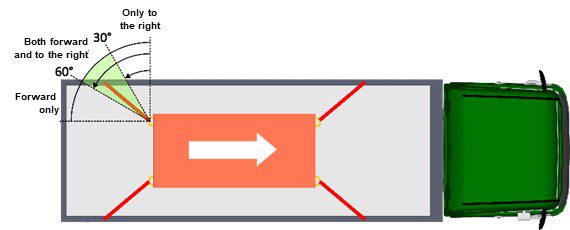
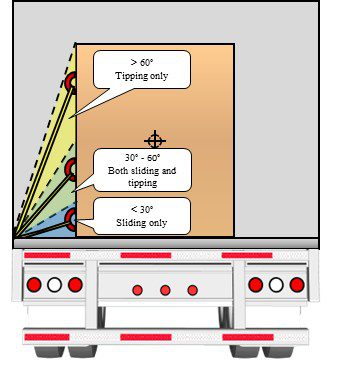
It is important to understand which movements and in which directions the straight lashings act, and this in turn depends on the angles at which they are applied. The basic principle is to apply the lashings at an angle of 30 – 60˚ in both the longitudinal and lateral directions, as well as in the vertical direction, and they can then prevent both sliding and tipping in two directions per lashing. If, on the other hand, the angle is 0° or 90°, the lashing only absorbs force in one direction.
Generally speaking, the greater the angle between the lashing eye and the attachment point, the more cargo the lashing can prevent from tipping. Conversely, the smaller the angle between the lashing eye and the attachment point, the more cargo the lashing can prevent from sliding.
Round Turn Lashing
A circumferential lashing is a cargo securing method that can be applied both horizontally and vertically. This type of lashing is used to tie a number of packages together in order to increase stability and reduce the risk of tipping.

A vertical round turn lashing can also prevent sliding between load layers. For this type of lashing, the pre-tensioning force should be as high as possible.
Contact
Send a message
Contact details
Contact person
Phone
Address
MariTerm AB
Sporthallsvägen 2A
263 35 Höganäs
Sweden